Infinitus AI · Healthcare · 2023–Present · Patent Co-Inventor

AI Copilot

Infinitus automates healthcare phone calls using AI, cutting days of manual work down to minutes. As Staff Product Designer and Design Manager, I led the design of the AI Copilot: the internal tool that gives operations teams visibility, control, and trust in an agentic system handling millions of calls.

My Role

Staff Product Designer & Design Manager

Team

VP of Product
Engineering leads
Operations & QA teams
ML & data science

Methods

Jobs-to-be-done research
Workflow & systems mapping
UX/UI/IXD
Design prototyping
Usability testing
Design QA

The Problem

AI at scale needs human oversight, and that oversight needs design

Infinitus's AI agent handles millions of healthcare phone calls on behalf of providers, verifying benefits, scheduling, and retrieving patient information. As the system scaled, operations teams needed a way to monitor, review, and intervene in AI-handled calls without slowing the throughput that made the product valuable.

The challenge: design a Copilot interface that surfaces the right information at the right time, builds operator trust in autonomous decisions, and enables fast, confident action when human judgment is needed.

Before AI Copilot, the inherited version. I did not design this state.

When I joined Infinitus, the AI Copilot was a functional but sprawling internal tool that had grown organically alongside the product. No dedicated designer had shaped it. Below is what it looked like on day one.

AI Copilot — the inherited interface, pre-redesign

The inherited AI Copilot interface, before any design involvement

AI Copilot detail view, pre-redesign
AI Copilot alternate state, pre-redesign

Process

Understanding human-AI collaboration at work

Discovery
Workflow Mapping
Concept Design
Prototyping
Iteration

Discovery was a structured research program across the five user groups who touch the AI Copilot: benefit verification specialists, A/R claims specialists, team leads, supervisors, and managers. I led every interview personally, working from role-specific discussion guides that opened on day-to-day workflow and laddered up to what “confident handoff to AI” meant for each role. The sessions were semi-structured: I wrote a guide tailored to each role, built new ones as needs emerged, and followed any thread worth digging into wherever it opened mid-interview.

To go beyond what people could articulate on a video call, I flew on-site to a customer’s headquarters for multi-day shadowing with their benefit verification team. Watching the work in the room (the second screen they kept open, the spreadsheets they pasted from, the colleagues they tapped on the shoulder) surfaced friction no remote interview would have caught.

What I heard back wasn’t one uniform need. Specialists wanted clarity in the moment. Team leads needed real-time signal on who was struggling without breathing down anyone’s neck. Supervisors and managers needed an oversight surface, so I designed a separate admin view for reviewing operator work, tracking performance, and turning Copilot call data into team-level insights they could act on.

Workflow mapping then revealed how the existing tooling forced operators to jump between multiple internal dashboards to piece together call context, creating lag in escalation decisions and error risk in high-stakes healthcare work. From there, I led concept design and rapid prototyping cycles with engineering and ML partners, pressure-testing assumptions about when AI confidence scores were meaningful vs. misleading to non-technical operators.

Role-specific discussion guide

5 user groups · ~45 min · led every session personally
01 Day-to-day workflow
  • Walk me through a typical call, start to finish.
  • Besides Zoom and payor portals, what other platforms or tools are you using throughout your day?
  • How do you wrap up or process tasks after a call, and how much time does that take?
02 Metrics & accountability
  • What specific metrics or KPIs are you held accountable for?
  • What matters most to you: calls started, calls completed, or patients helped?
  • How does your manager or supervisor measure success for your role?
03 Technical friction
  • What do you generally do first when you hit a technical problem on a call?
  • How often do you encounter audio issues, and how do you troubleshoot them mid-call?
  • What IVR tips or workarounds have you built up over time?
04 Role, challenges & motivation
  • What is the most challenging or time-consuming task in your role? Why?
  • Which step do you believe is the most critical in your workflow?
  • What excites you most about your role, and what part do you love?
Close-out · 3 min

Anything we didn’t cover that could help us? Questions for the team, or topics you think we missed?

Appendix · question bank

Standby probes for terms and edge cases (e.g. “What does Auto-IVR mean to you?”) so sessions stayed conversational without losing rigor.

A representative sample of the kinds of questions these role-specific guides covered, not the full bank, and not the full set of guides I wrote.

These sessions produced more than notes. I synthesized the learnings into end-to-end user flows: a shared artifact mapping how each role moves through the Copilot across its rollout phases, from new-user setup through the pilot and post-pilot updates. A flow like the one below gave customers and internal partners something concrete to align around, turning scattered interview insights into one picture of the workflow, its pain points, and how the Copilot would meet each need.
An example AI Copilot user flow synthesized from the research, used to drive alignment with customers and internal partners across setup, pilot, and post-pilot phases.

Solution

A Copilot that makes AI legible and actionable

The AI Copilot consolidates call monitoring, live transcription review, escalation queuing, and outcome auditing into a single, unified interface. Key design decisions included:

  • Confidence-aware UI: visual indicators that communicate model uncertainty in plain language, not raw percentages, so operators can triage quickly without ML expertise.
  • Contextual escalation flows: one-click intervention paths that preserve call context, reducing the time-to-escalate from minutes to seconds.
  • Audit trail design: structured call summaries that satisfy compliance requirements while remaining scannable for ops teams under volume pressure.

The patent I co-invented covers a novel method for routing AI-generated call outcomes through human review loops, a direct product of the design systems work on this project.

Today AI Copilot, my design
AI Copilot — current design

AI Copilot: the redesigned interface

An operator’s session, end to end

One continuous mobile-style surface from queue-on to wrap-up. Personal “today” metrics, wait-time transparency, and small reminders keep operators oriented across a high-volume shift, while the team queue routes the next call automatically so no one cherry-picks.

Home with the queue paused: daily metrics keep operators oriented across a shift.
Auto-match from the team queue. Your wait time vs. team average is visible so the load feels fair.
Live call view. The Copilot proactively suggests attaching a matching task it found while you’re on the line.
Task detail: full claim, provider, and case context anchored to the active call so context-switching disappears.
Wrap-up: resolution, a quick self-rating that feeds quality signals, and a countdown before the next call.
Back to the queue. Today’s metrics now reflect the call you just completed, ready for the next match.
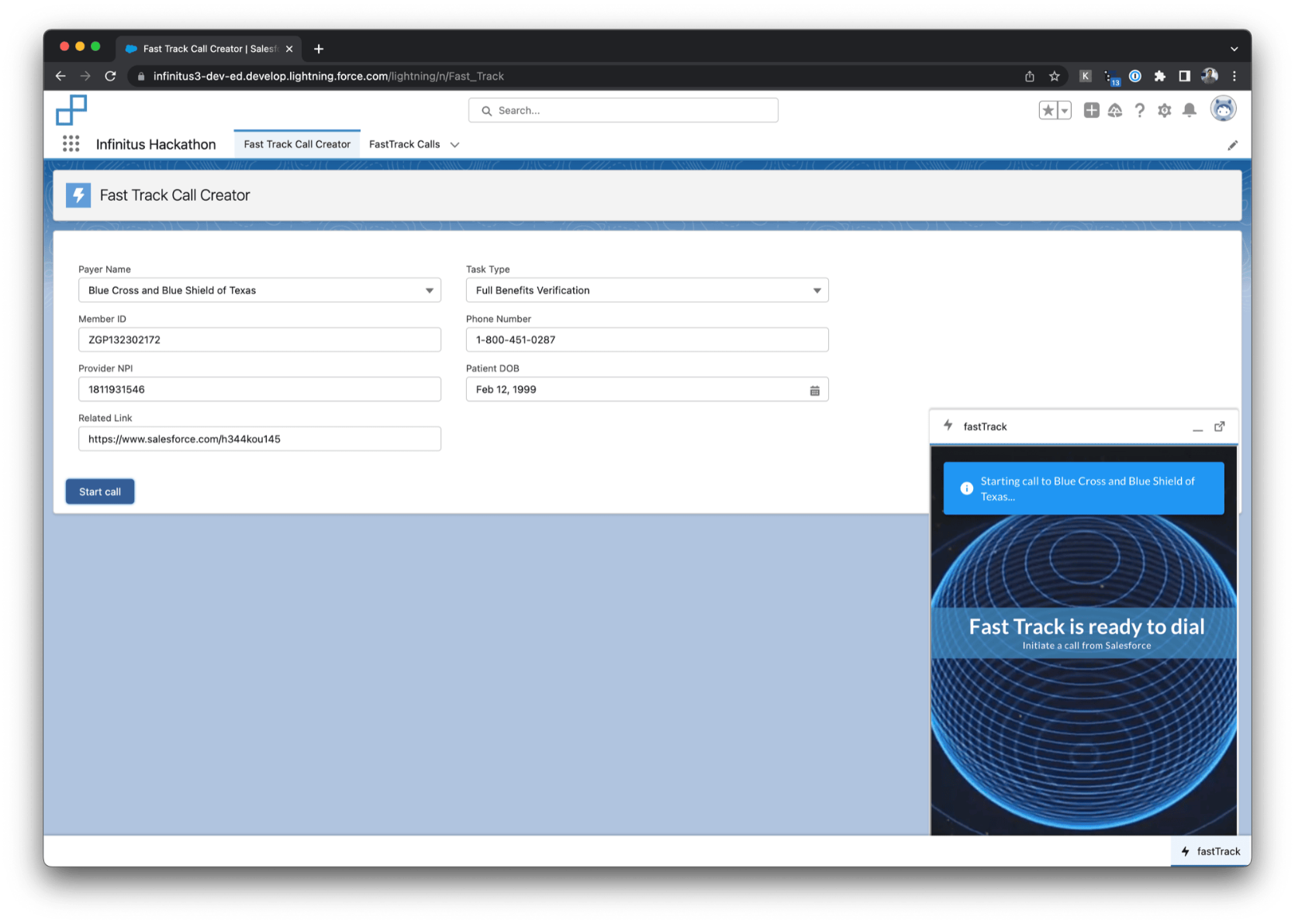
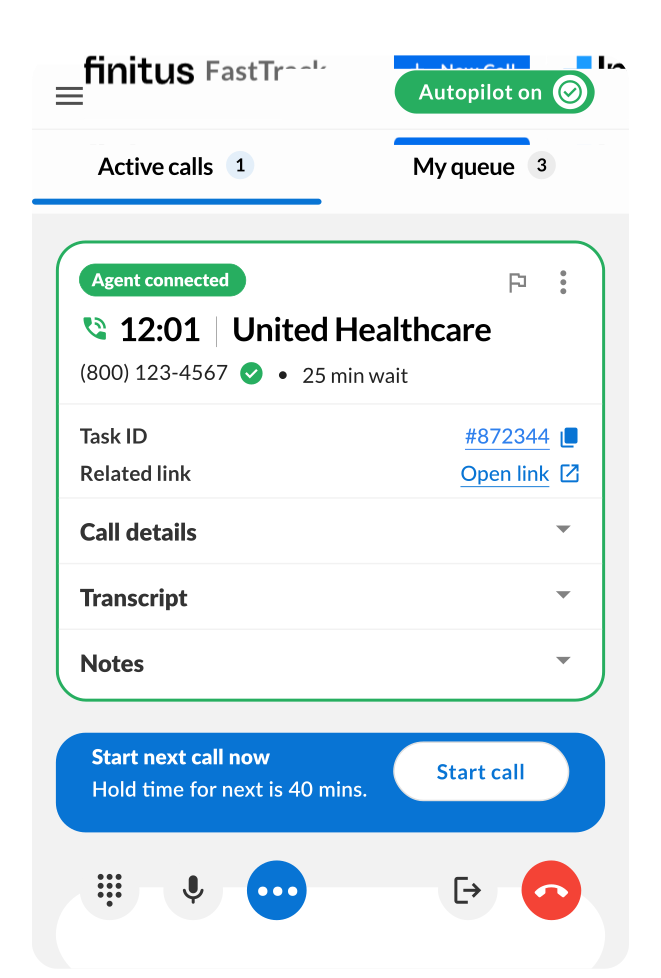
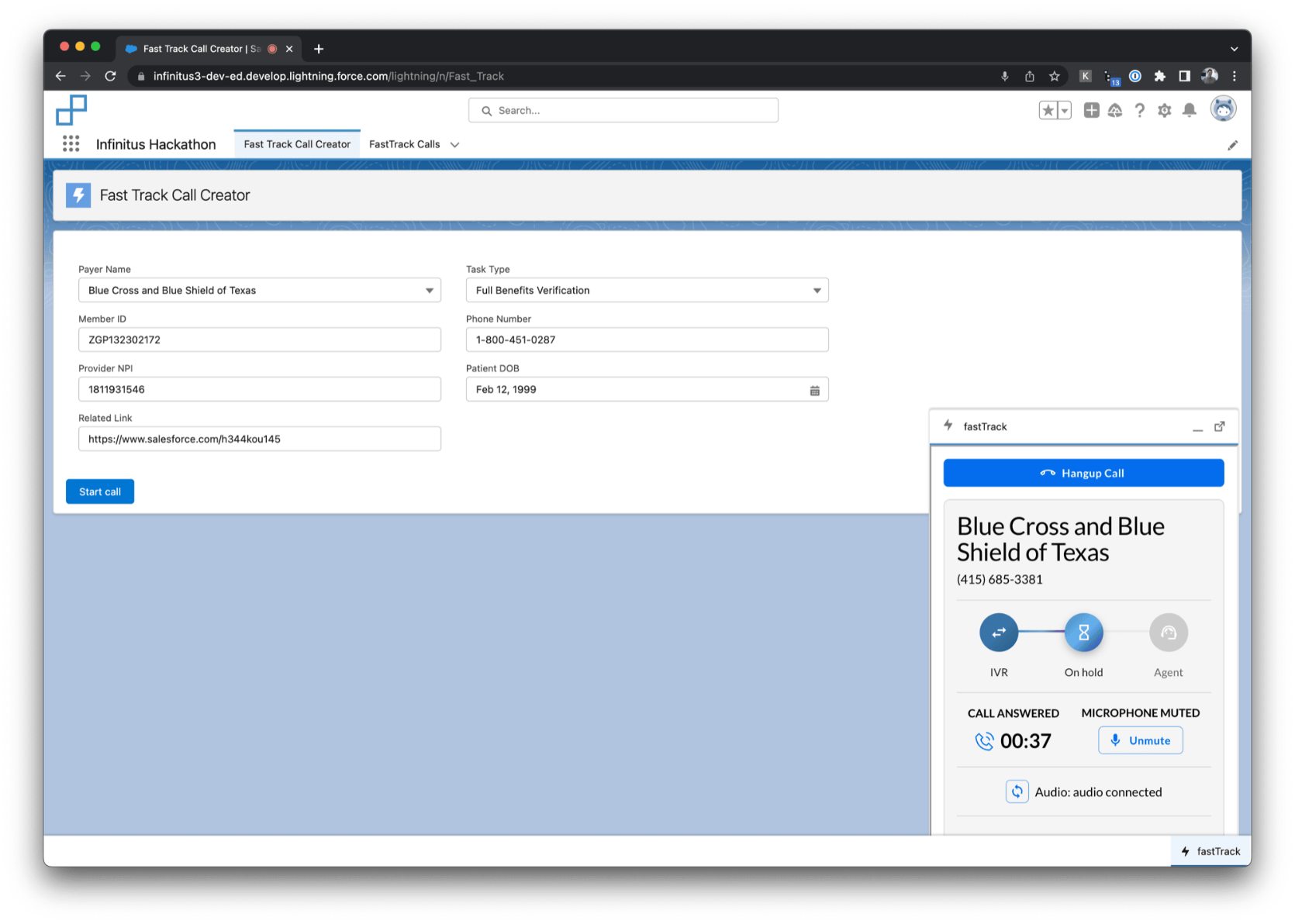
Copilot integrated with Epic FastTrack. Copilot also integrates with other CRMs and EHRs.

Outcomes

Measurable impact across speed, quality, and scale

86.7%

Reduction in operator time on IVR & hold per successful call

82,835 min

Operator time saved in a single month (April 2026)

13,947

Successful payer calls handled in a single month

$1.4M

ARR, up 2× YoY and on a near-term path to $10M

Qualitative

  • Only 1.7% of failed calls were attributable to the AI itself. The rest were user-abandoned, bad data, or payer system issues, evidence that the Copilot’s confidence signals were honest about when to escalate and when to keep going.
  • A small ops team worked ~13K payer tasks daily. 18 active users averaged 8.4 successful calls each per day, with the Copilot’s queue prioritizing what needed human attention instead of forcing review of every call.
  • Scaling didn’t require scaling headcount. Throughput and revenue grew on the same operator footprint, the original design bet behind the Copilot.

Next

Where the AI Copilot goes from here

Now In active design with the customer advisory board

AI Copilot: Live Assist. The current Copilot enables oversight of calls after or during a review pass. The next evolution removes that lag entirely, collapsing the gap between AI action and human judgment:

  • Real-time call monitoring & live transcription. Operators see and hear what the AI agent is doing as it happens, not after the fact.
  • AI recommendations in an ambient panel. Suggested next-best actions, flagged moments, and contextual notes surface inline so operators can act without leaving the call view.
  • Listen in, or jump in. One tap to silently audit a live call; one more to take over when human judgment is needed.
  • Connected to Infinitus’s intelligence layers. Insights from the broader platform (payer behavior, historical outcomes, claim patterns) surface where the work is happening, not in a separate tool.
  • Validated with the customer advisory board. Designed and prototyped in close collaboration with SVPs and VPs of Patient Access Operations, and validated at the executive level as the direction they want to evolve toward.
Click to interact

Interactive prototype, built with Figma Make and validated with customer advisory board executives